Friday, 13 March 2020

Stack and Queue

Difference between Stack and Queue Data Structures

Stack A stack is a linear data structure in which elements can be inserted and deleted only from one side of the list, called the top. A stack follows the LIFO (Last In First Out) principle, i.e., the element inserted at the last is the first element to come out. The insertion of an element into stack is called push operation, and deletion of an element from the stack is called pop operation. In stack we always keep track of the last element present in the list with a pointer called top.
The diagrammatic representation of stack is given below:
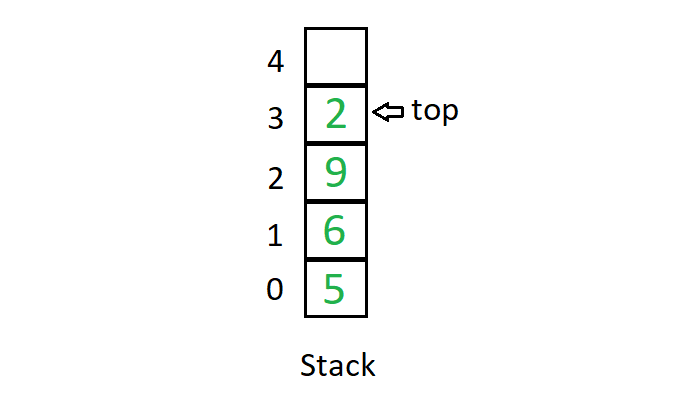
Stacks


Queue: A queue is a linear data structure in which elements can be inserted only from one side of the list called rear, and the elements can be deleted only from the other side called the front. The queue data structure follows the FIFO (First In First Out) principle, i.e. the element inserted at first in the list, is the first element to be removed from the list. The insertion of an element in a queue is called an enqueue operation and the deletion of an element is called a dequeue operation. In queue we always maintain two pointers, one pointing to the element which was inserted at the first and still present in the list with the front pointer and the second pointer pointing to the element inserted at the last with the rear pointer.
The diagrammatic representation of queue is given below:
Queue
Difference between Stack and Queue Data Structures
STACKSQUEUES
Stacks are based on the LIFO principle, i.e., the element inserted at the last, is the first element to come out of the list.Queues are based on the FIFO principle, i.e., the element inserted at the first, is the first element to come out of the list.
Insertion and deletion in stacks takes place only from one end of the list called the top.Insertion and deletion in queues takes place from the opposite ends of the list. The insertion takes place at the rear of the list and the deletion takes place from the front of the list.
Insert operation is called push operation.Insert operation is called enqueue operation.
Delete operation is called pop operation.Delete operation is called dequeue operation.
In stacks we maintain only one pointer to access the list, called the top, which always points to the last element present in the list.In queues we maintain two pointers to access the list. The front pointer always points to the first element inserted in the list and is still present, and the rear pointer always points to the last inserted element.

Hash table and binary tree

Hashing

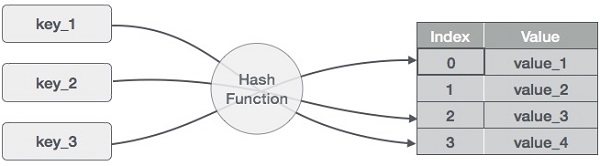
Hashing is a technique to convert a range of key values into a range of indexes of an array. We're going to use modulo operator to get a range of key values. Consider an example of hash table of size 20, and the following items are to be stored. Item are in the (key,value) format.
Hash Function
  • (1,20)
  • (2,70)
  • (42,80)
  • (4,25)
  • (12,44)
  • (14,32)
  • (17,11)
  • (13,78)
  • (37,98)
Sr.No.KeyHashArray Index
111 % 20 = 11
222 % 20 = 22
34242 % 20 = 22
444 % 20 = 44
51212 % 20 = 1212
61414 % 20 = 1414
71717 % 20 = 1717
81313 % 20 = 1313
93737 % 20 = 1717

Linear Probing

As we can see, it may happen that the hashing technique is used to create an already used index of the array. In such a case, we can search the next empty location in the array by looking into the next cell until we find an empty cell. This technique is called linear probing.
Sr.No.KeyHashArray IndexAfter Linear Probing, Array Index
111 % 20 = 111
222 % 20 = 222
34242 % 20 = 223
444 % 20 = 444
51212 % 20 = 121212
61414 % 20 = 141414
71717 % 20 = 171717
81313 % 20 = 131313
93737 % 20 = 171718

Basic Operations

Following are the basic primary operations of a hash table.
  • Search − Searches an element in a hash table.
  • Insert − inserts an element in a hash table.
  • delete − Deletes an element from a hash table.

DataItem

Define a data item having some data and key, based on which the search is to be conducted in a hash table.
struct DataItem {
   int data;
   int key;
};

Hash Method

Define a hashing method to compute the hash code of the key of the data item.
int hashCode(int key){
   return key % SIZE;
}

Search Operation

Whenever an element is to be searched, compute the hash code of the key passed and locate the element using that hash code as index in the array. Use linear probing to get the element ahead if the element is not found at the computed hash code.

Example

struct DataItem *search(int key) {
   //get the hash
   int hashIndex = hashCode(key);
 
   //move in array until an empty
   while(hashArray[hashIndex] != NULL) {
 
      if(hashArray[hashIndex]->key == key)
         return hashArray[hashIndex];
   
      //go to next cell
      ++hashIndex;
  
      //wrap around the table
      hashIndex %= SIZE;
   }

   return NULL;        
}

Insert Operation

Whenever an element is to be inserted, compute the hash code of the key passed and locate the index using that hash code as an index in the array. Use linear probing for empty location, if an element is found at the computed hash code.

Example

void insert(int key,int data) {
   struct DataItem *item = (struct DataItem*) malloc(sizeof(struct DataItem));
   item->data = data;  
   item->key = key;     

   //get the hash 
   int hashIndex = hashCode(key);

   //move in array until an empty or deleted cell
   while(hashArray[hashIndex] != NULL && hashArray[hashIndex]->key != -1) {
      //go to next cell
      ++hashIndex;
  
      //wrap around the table
      hashIndex %= SIZE;
   }
 
   hashArray[hashIndex] = item;        
}

Delete Operation

Whenever an element is to be deleted, compute the hash code of the key passed and locate the index using that hash code as an index in the array. Use linear probing to get the element ahead if an element is not found at the computed hash code. When found, store a dummy item there to keep the performance of the hash table intact.

Example

struct DataItem* delete(struct DataItem* item) {
   int key = item->key;

   //get the hash 
   int hashIndex = hashCode(key);

   //move in array until an empty 
   while(hashArray[hashIndex] !=NULL) {
 
      if(hashArray[hashIndex]->key == key) {
         struct DataItem* temp = hashArray[hashIndex]; 
   
         //assign a dummy item at deleted position
         hashArray[hashIndex] = dummyItem; 
         return temp;
      } 
  
      //go to next cell
      ++hashIndex;
  
      //wrap around the table
      hashIndex %= SIZE;
   }  
 
   return NULL;        
}